
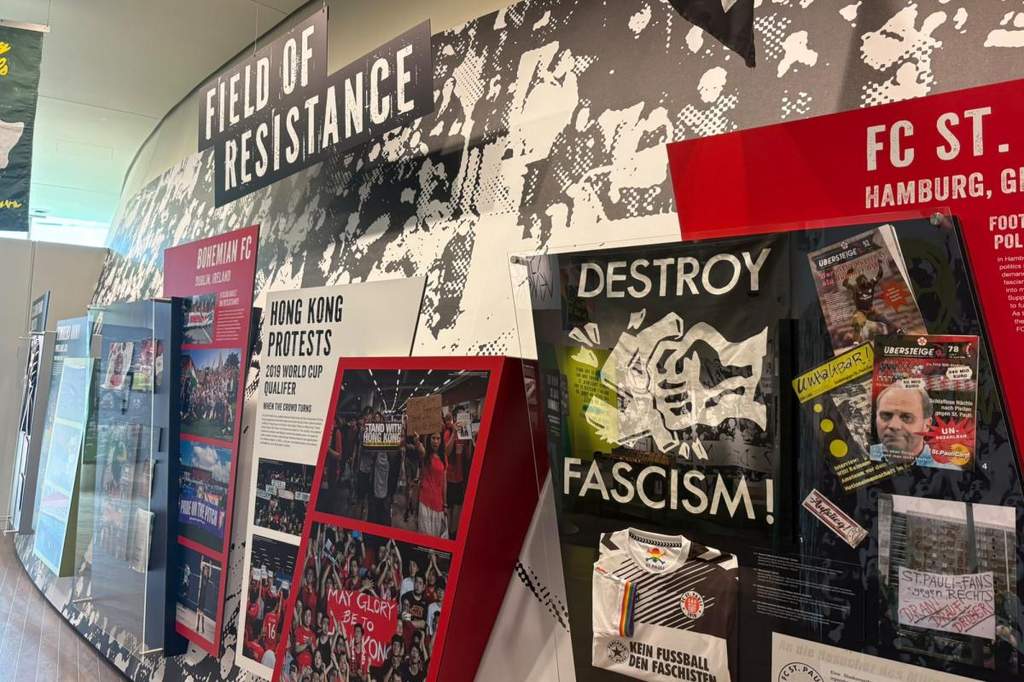
A massive banner written in German immediately sets the tone at the entrance: "Yield nothing to fascists." This striking display welcomes visitors to the first floor of the National Center for Civil and Human Rights in Atlanta, which recently inaugurated a year-long exhibition titled "The People's Game: Football and Human Rights". Based on a report by Romain Lafont for L'Équipe, the exhibition showcases historic and contemporary acts of civic resistance by both global sports icons and anonymous activists.
// RELATED STORIES

Enjoying this article?
Get even more captivating stories by subscribing to our newsletter. It's free!
Subscribe Sekarang →The venue carries an undeniable solemnity, situated less than three kilometers from the birthplace and final resting place of Martin Luther King Jr. According to editorial team observations from local monitoring, the location highlights the somewhat split cultural identity of the United States, as the human rights museum stands directly adjacent to the World of Coca-Cola and the College Football Hall of Fame.
The exhibition spans ninety years of football history, featuring stories such as the Basque national team formed in 1936 in opposition to General Franco's rise to power in Spain, which eventually competed in the Mexican league. Visitors can also explore the history of French national team players who left France in 1958 to form the FLN team, touring internationally to advocate for Algerian independence. The exhibit even displays the April 15 front page of L'Équipe archive headline: "Nine Algerian footballers (including Zitouni) disappear." Other highlights include Socrates and the "Corinthian Democracy" movement acting as a peaceful resistance against the Brazilian dictatorship.
Beyond historical political movements, the curation highlights fan-led activism. It covers the well-known anti-racist and anti-homophobic initiatives of German club FC Sankt Pauli and Ireland's Bohemian FC, which also runs education and environmental awareness programs. The exhibition offers a highly visual journey through global events, ranging from South African football during Apartheid to Afghanistan, and the symbolic moment when Didier Drogba and his Ivorian teammates knelt after qualifying for the 2006 World Cup to successfully plead for an end to their country's civil war.
The inspiration for the project stems from a desire to shift public perception in North America. "In the United States, mainstream media only talks about football when something negative happens: racism, violence...," explained Daniel Fuller, the exhibition's curator and a dedicated Paris Saint-Germain fan. Having attended matches in France, the Netherlands, and South America, Fuller noted that his personal experiences contradicted this bleak view. "The idea came about to counter this negative narrative from the media in the United States," he added.
Following months of preparation and research trips to Hamburg, Dublin, and São Paulo, the exhibition also shines a spotlight on local American initiatives. Among them is the Fugee Family, an organization based in Clarkston, Georgia, dedicated to the education of refugees and migrants through daily soccer practices.
Another featured local initiative is "Soccer in the Streets," which utilizes urban infrastructure for social inclusion. Fuller explained that the organization noticed vacant spaces beneath Atlanta's elevated transit lines. After coordinating with the transit authority and city hall, they built soccer pitches on these empty lots. "Children play on weekends, there are now food trucks, yoga classes, music... They brought life to places that didn't have any," Fuller remarked, noting that transit accessibility is crucial in a car-dependent metropolis.
From editorial monitoring of the event, the exhibition has already attracted high-profile figures from the sporting world. Representatives from FIFA and George Weah, the 1995 Ballon d'Or winner and honorary captain of FIFA's players" voice panel against racism, have visited the museum. In the corridor leading to the main hall, Weah's signed jersey is displayed alongside shirts from legends like Pelé, Paolo Maldini, Rivaldo, and young star Lamine Yamal, celebrating the true universality of the sport.